
Verify Hotel Amenities in 5–10 Minutes with Phone Scripts and a Hot Tub Check
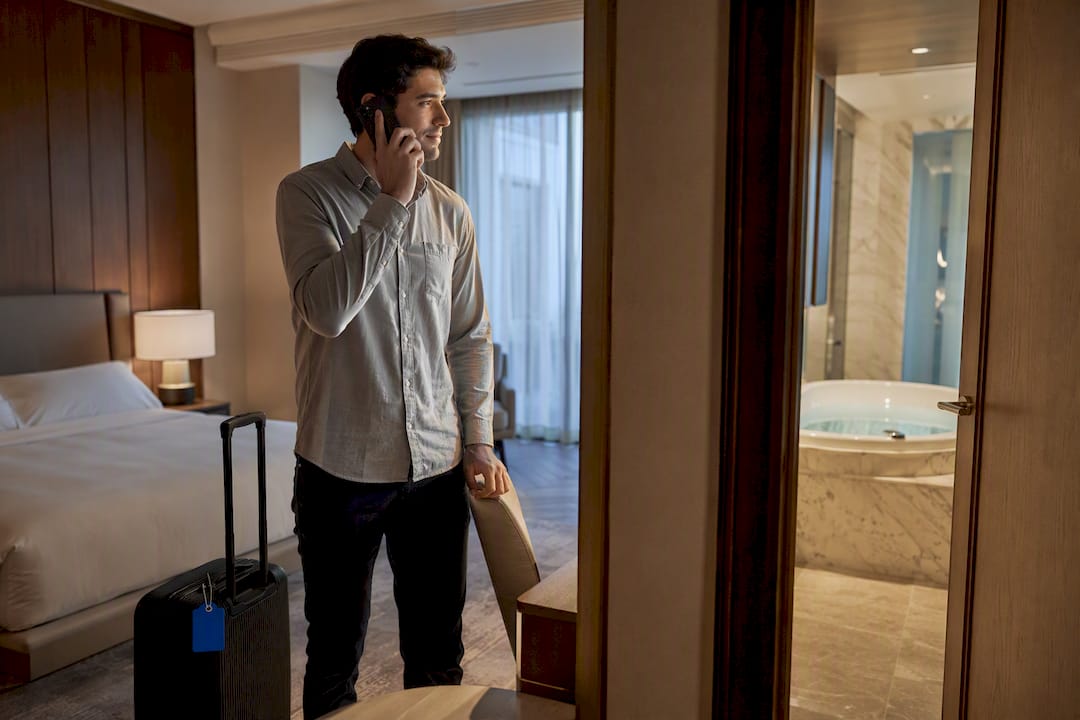
Verify an amenity by checking it in three places: the hotel’s own room and rate pages, recent guest evidence like photos and reviews, and, for anything mission-critical, a written confirmation from the hotel itself. A private hot tub, an EV charger, or guaranteed parking deserve a phone call or email on top of the listing. Budget five to ten minutes for low-stakes items and closer to twenty for anything that could ruin the trip if it’s wrong.
TL;DR:
- Check recent guest reviews, photos, and hotel responses within the last 30 to 90 days to verify the current availability of amenities.
- Confirm amenities directly with the hotel through written communication for critical features like hot tubs or parking, and save the proof.
- Use multiple sources—hotel website, Google profile, third-party reviews, and traveler photos—to cross-verify amenity accuracy and avoid outdated or misleading information.
- Be aware that seasonal closures, capacity limits, and room-type restrictions often limit the usability of amenities on your actual travel dates.
- Filter verified listings or use pre-verified options to save time and avoid misleading claims, especially when booking on tight schedules.
Table of Contents
- How to Verify Hotel Amenities Fast (5 to 10 Minute Checklist)
- Where Should You Check Hotel Amenity Claims?
- How Do You Read Reviews and Photos for Verification?
- What Operational Details Can Limit an Amenity?
- What Should You Say When You Call or Message the Hotel?
- How Do You Verify Specific Amenities Like Pools, Parking, and EV Chargers
- What Tools Speed Up Amenity Verification?
- How Hotel Hot Tubs Verifies Private In-Room Hot Tubs
- Two Habits I’d Tell Any Traveler to Build
- Skip the Guesswork With Pre-Verified Jacuzzi Listings
- Sources
How to Verify Hotel Amenities Fast (5 to 10 Minute Checklist)
Run through these steps in order. Each one either confirms the amenity or raises a flag worth chasing down before you enter payment information.
- Read the room-category page and FAQ on the hotel’s own site. Look for exact wording. “In-room jacuzzi” and “on-site hot tub” mean two very different things, and hotels sometimes bury the distinction in a footnote.
- Pull up the hotel’s Google Business Profile. Check the amenity tags Google displays, scroll through the Q&A section, and note the dates on the most recent photos.
- Scan two or three recent reviews across different platforms. You’re looking for repeated, specific mentions of the amenity, not just a star average.
- Look at traveler photos and short video walkthroughs. A guest’s phone video of the actual room tells you more in thirty seconds than a paragraph of marketing copy.
- Check the booking page’s rate rules and fee notes. This is where resort fees, parking surcharges, and “seasonal availability” language tend to hide.
- Call or message the hotel directly if the amenity is central to your trip. Ask for written confirmation or a screenshot tied to your specific room category.
This sequence mirrors the approach recommended in a pre-arrival research framework that emphasizes sorting reviews by date and cross-referencing the hotel’s own description against third-party listings before trusting either one alone.
Pro Tip: Do steps 1 through 4 before you even open a chat window with the hotel. Half the time, the answer is already sitting in a two-month-old review or a Google Q&A thread, and you’ll skip the call entirely.
Where Should You Check Hotel Amenity Claims?
Different sources prove different things, and knowing which one to trust for which claim saves you from chasing bad information.
- The hotel’s official website is authoritative on paper but written by marketing, not operations. Look for room-type-specific language rather than generic “resort-style amenities” phrasing, and check whether the FAQ page has a visible last-updated date.
- OTAs and third-party booking pages often show rate-specific rules that the hotel’s own site skips, and they sometimes label rooms differently than the property does. If Expedia calls it a “Jacuzzi Suite” and the hotel’s site never uses that phrase, that gap is worth investigating before you book.
- Google Business Profile is one of the best free tools available, mainly because it aggregates data from multiple sources. Google explains that hotel amenity information comes from hoteliers, third-party partners, direct research, and user feedback, which means the profile often reflects reality faster than a hotel’s own slow-to-update website. Check the amenity tags, read the Q&A, and pay attention to whether the owner actually responds to questions.
- Review platforms matter more for pattern-spotting than star ratings. A 4.6-star hotel with three different guests independently mentioning “hot tub was drained for the season” in the last month tells you more than the overall score does.
- Maps and traveler photos confirm physical reality. Satellite views and geotagged guest photos can verify whether a “beachfront” claim is accurate or whether that “on-site parking” is actually a lot two blocks away.
None of these sources is complete on its own. The hotel’s site tells you what they’re advertising, the OTA tells you what’s actually bookable, Google tells you what’s been reported recently, and guest photos tell you what’s real.
How Do You Read Reviews and Photos for Verification?
Recent, detailed reviews beat old five-star ratings every time. A review from three years ago describing a rooftop pool doesn’t tell you whether that pool is open this month, or whether it survived last winter’s renovation budget.
When scanning review text, search for targeted phrases rather than skimming for tone: “in-room hot tub,” “jacuzzi suite,” “pool closed,” “charging station taken,” or “paid parking” will surface the specific detail you need faster than reading star ratings alone. Travel expert Samantha Brown advises watching on-camera video reviews and paying attention to review volume, not just average rating, since a handful of five-star reviews can be an outlier while fifty consistent reviews are a pattern.
Video reviews and timestamped photos carry more weight than text alone, mainly because they’re harder to fake and easier to date. Check the upload date on any video before you trust it as current.
Watch for these red flags:
- Identical or near-identical phrasing across multiple reviews, which often signals incentivized or fake reviews.
- Zero guest photos of an amenity the hotel prominently advertises. If a hotel has 400 reviews and not one guest photo of the “stunning rooftop pool,” something doesn’t add up.
- Repeated recent mentions of “closed,” “under renovation,” or “not currently available.”
Industry sources recommend a three-signal rule for anything mission-critical: don’t trust the amenity until you’ve confirmed it through official text, a recent independent review, and a traveler photo. Getting two out of three isn’t enough when the whole trip hinges on one feature.
What Operational Details Can Limit an Amenity?
An amenity existing and an amenity being usable on your actual travel dates are two different things. This is where most disappointed guests get burned, not because the hotel lied, but because nobody checked the fine print.
- Check hours and seasonal availability. Rooftop pools and outdoor hot tubs frequently close for winter, and “seasonal” rarely gets a bold headline on the booking page.
- Look for reservation or capacity rules. Gyms, pools, and private hot tubs sometimes require booking a time slot, and some properties cap capacity during peak weekends.
- Confirm whether the amenity is on-site or run by a third party. A “shuttle to the beach club” or “partner gym access” is not the same as an on-property pool, even when the listing photo makes it look that way.
- Verify access ties to room type or loyalty status. Some hotels reserve the private hot tub or lounge access for specific suite categories or elite-tier members only, a distinction that rarely shows up in the headline amenity list.
- Resolve anything ambiguous through the hotel’s FAQ, the booking rate rules, or a direct message. A practical amenity comparison framework suggests labeling every amenity you care about as included, paid, or conditional before you finalize a booking, which forces you to actually check rather than assume.
What Should You Say When You Call or Message the Hotel?
For anything that would ruin the trip if it turns out to be wrong, skip the guesswork and just ask. A two-minute phone call resolves more ambiguity than an hour of review-reading.
Phone script: “Hi, I’m looking at booking [room category] for [dates]. Can you confirm whether that room includes [amenity], and whether it’s available for my entire stay?” Listen for hedging. “It should be available” is a different answer than “yes, that room type includes a private in-room jacuzzi.”
Email or chat script: “Could you confirm in writing that [room category] includes [amenity] for [check-in date] to [check-out date]? A screenshot of the room description or FAQ page would be appreciated.” Written confirmation matters because a phone agent’s verbal promise disappears the moment you hang up.
Acceptable proof looks like one of these:
- A screenshot of the room description or FAQ page, dated or timestamped.
- The exact rate-rule text quoted back to you in an email.
- A reservation number cross-referenced against the specific room category, not just “a room.”
Once you get a response, document it. Screenshot the confirmation, save the email thread, and note the staff member’s name and the date of the exchange. If a dispute comes up at check-in, that record is what gets you moved to the correct room instead of arguing with a front desk clerk who has no idea what you were promised.
Pro Tip: If a hotel representative won’t put an amenity confirmation in writing, treat that hesitation as information. A property confident in its amenities has no reason to dodge a simple email request.
How Do You Verify Specific Amenities Like Pools, Parking, and EV Chargers
Some amenities need their own verification routine because they carry hidden conditions that generic checklists miss.
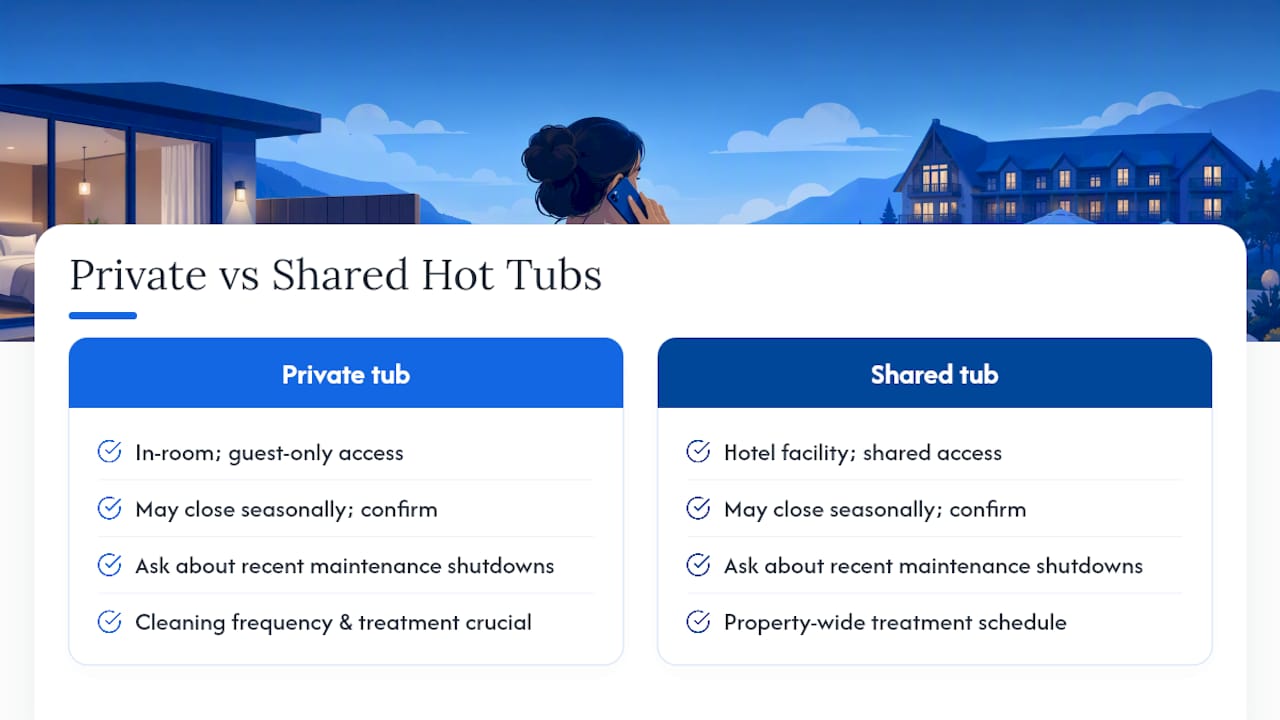
Pools and hot tubs. Confirm whether the tub is a private in-room unit or a shared facility, since listings sometimes blur this distinction on purpose. Ask about seasonal closures, recent maintenance shutdowns, and how frequently the water is treated and inspected. If you’re specifically hunting for a private in-room hot tub, the cleaning and operational questions matter as much as whether the tub exists at all.
EV chargers. Find out how many plugs the property actually has, not just whether it “offers EV charging.” Ask about connector type, charging speed, whether reservations are required, and whether non-guests can occupy the spots. A hotel with two Level 2 chargers for 200 rooms is a very different reality than the amenity list suggests.
Parking. Determine whether parking is on-site or off-site, whether there are height restrictions for larger vehicles, whether in-and-out privileges are included, and what the nightly rate actually is once fees are added. “Free parking” sometimes means free for the first vehicle only.
Breakfast. Check whether it’s included in the room rate or sold separately, whether it’s a full buffet or a grab-and-go setup, and what the actual serving hours are. A hotel that advertises “breakfast included” but serves it from 6:00 to 7:30 AM only isn’t lying, but it’s not delivering what most guests picture.
Accessibility. Confirm the specific features of an accessible room (roll-in shower, grab bars, door width) rather than trusting the generic “ADA accessible” label, and verify that related amenities like pool lifts or accessible parking spots are currently operational, not just installed.
What Tools Speed Up Amenity Verification?
A handful of digital shortcuts can cut your research time in half without sacrificing accuracy.
- YouTube room tours show current conditions, and checking the upload date tells you whether you’re looking at last month’s room or a five-year-old promotional video.
- Google Maps recent photos and review timestamps surface changes faster than a hotel’s own website typically updates.
- Reverse-image searching a suspiciously polished amenity photo can reveal whether it’s a stock image reused across multiple properties.
- Review-scanning services like StayCheck scan recent Booking, Google, and TripAdvisor reviews to flag live issues such as no hot water, ongoing construction, or Wi-Fi complaints, giving you a risk snapshot before you commit.
- Google Business Profile Q&A and owner responses show whether a property actually engages with guest questions or ignores them, which is its own kind of signal.
Treat AI-generated review summaries and aggregated scores as a starting point, never a guarantee. Those summaries compress nuance out of the picture, and the only way to catch a “pool closed for the season” detail is to trace the claim back to the primary source yourself.
How Hotel Hot Tubs Verifies Private In-Room Hot Tubs
Verifying a private in-room hot tub takes more scrutiny than most amenities because the failure mode is so specific: you book expecting privacy and get a shared spa down the hall instead.
Hotel Hot Tubs runs listings through layered checks before they’re published:
- Cross-referencing the hotel’s own room descriptions against booking-page language to catch discrepancies.
- Collecting photo evidence that shows the tub physically inside the room, not a shared facility elsewhere on the property.
- Confirming details directly with hotel staff rather than relying solely on scraped listing data.
- Weighing recent guest feedback to catch amenities that have changed since the listing was last updated.
Private hot tub claims need this kind of layered proof precisely because the room-level detail rarely makes it into general hotel marketing, and a shared jacuzzi getting mislabeled as “in-room” is a common source of guest disappointment. The full protocol is outlined on the How We Verify page.
Two Habits I’d Tell Any Traveler to Build
I check the last 30 to 90 days of reviews before booking anything, full stop. Older reviews describe a hotel that may no longer exist, whether that’s due to renovation, new management, or a maintenance budget that quietly dried up.
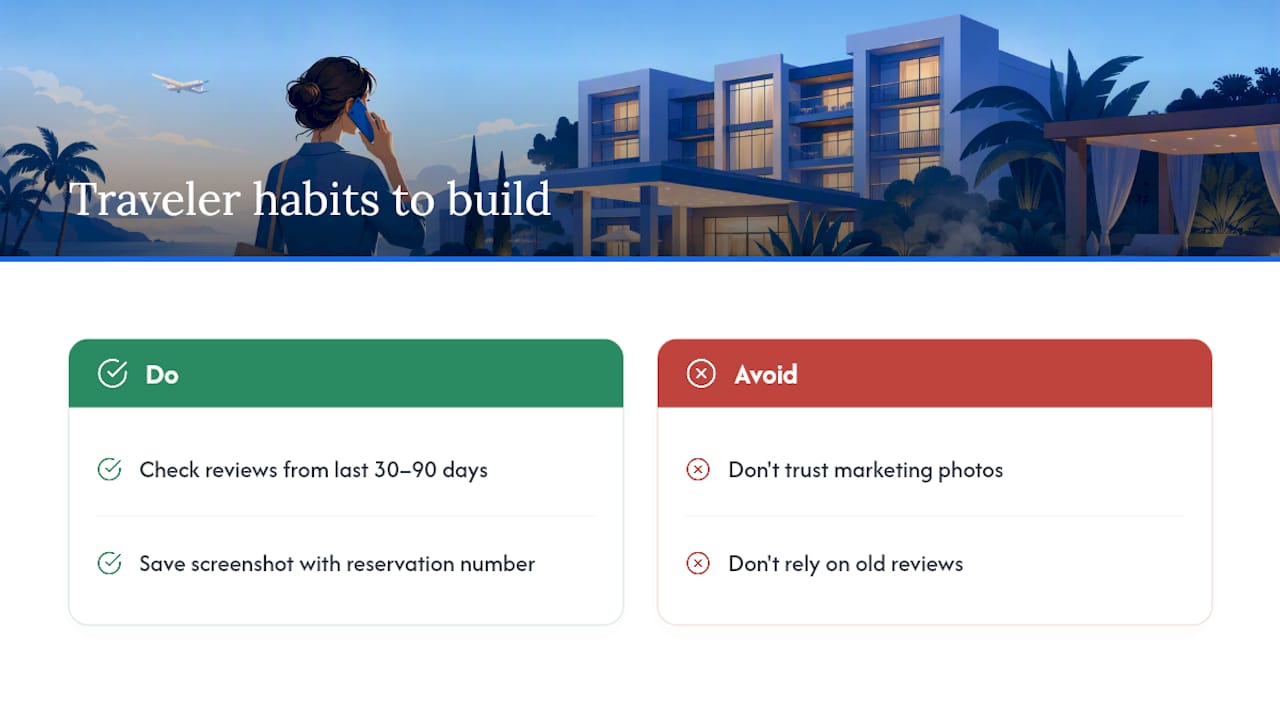
The second habit: I screenshot every written confirmation and make sure the reservation number is visible in the frame. A verbal promise from a front desk agent evaporates the moment the call ends, but a screenshot with a reservation number attached is something you can actually put in front of a manager.
The mistake I see most often is trusting marketing photos over recent guest evidence. Wide-angle lenses and heavy editing make rooms look bigger and amenities look newer than they are. A guest’s unfiltered phone photo from two weeks ago will always tell you more than a professional shoot from three years back. Marketing wants you to book. Recent guests just want to tell you what happened.
— Logan Oneal
Skip the Guesswork With Pre-Verified Jacuzzi Listings
Some travelers seek options with pre-verified “private in-room hot tub” claims to save time when planning trips on a deadline; consulting a comprehensive Mobile Data Checklist for Travelers can also ensure seamless connectivity for completing such verifications on the go. Some listings are cross-checked between room descriptions, photo evidence, and direct hotel confirmation to reduce the need for personal verification calls.
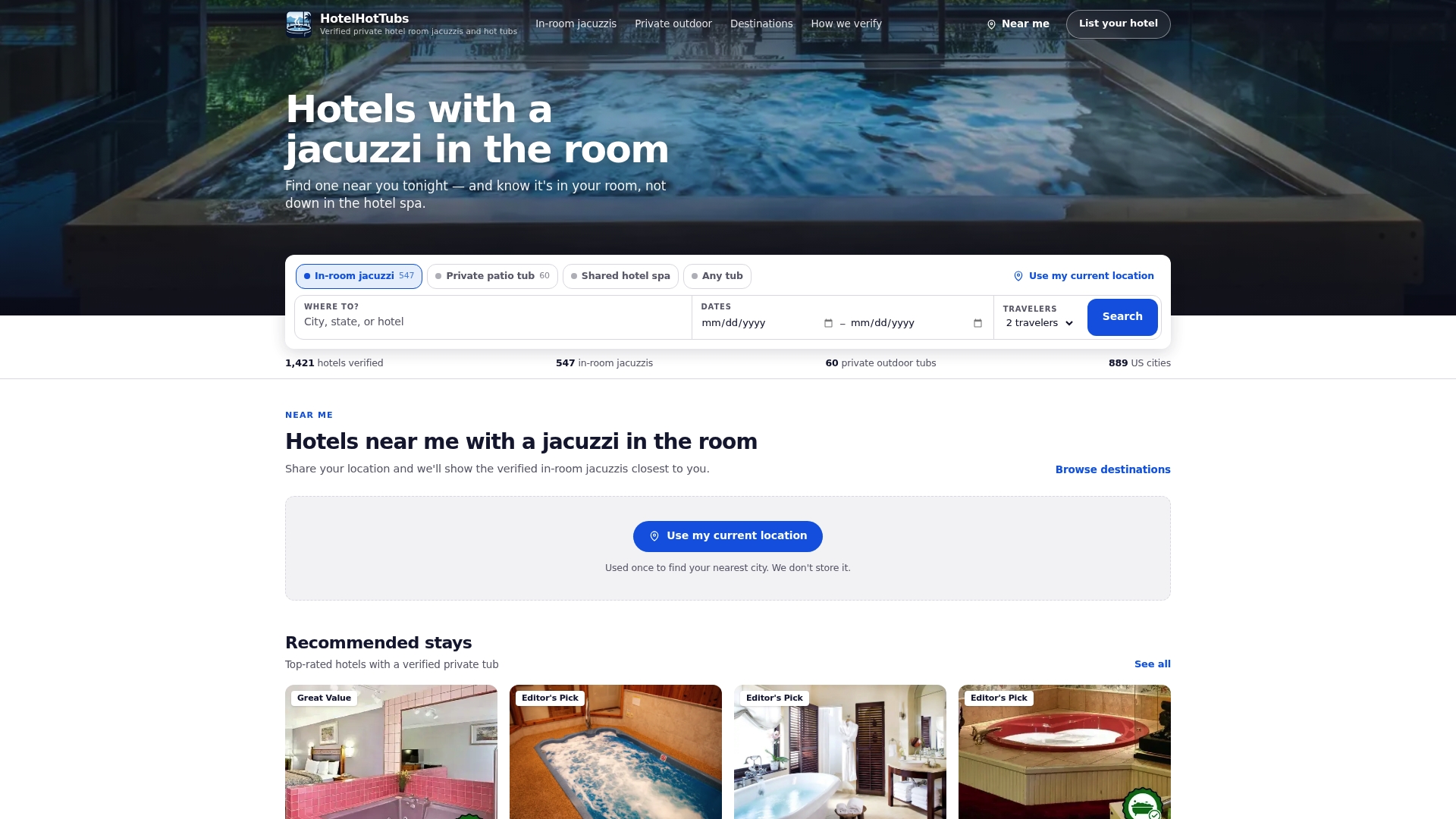
That pre-verification saves the exact five-to-ten-minute check this article outlined, multiplied across however many hotels you’d otherwise compare. Instead of opening multiple browser tabs to confirm whether “jacuzzi suite” actually means a private in-room tub, some platforms allow filtering by verified listings, price, location, and trip type. If budget is the deciding factor, start with hotels with jacuzzi rooms under $250 and browse listings that have already cleared the verification steps you’d otherwise run yourself.
Sources
- What To Do Before Booking A Hotel Room | HuffPost Life
- How Google collects and shows hotel amenities (Google Travel Help)
- StayCheck — scan recent reviews to reveal live hotel issues
- How to Evaluate a Hotel Before Booking: A Pre-Arrival Research Framework - SilverSky
- Hotel Amenities Comparison Guide